

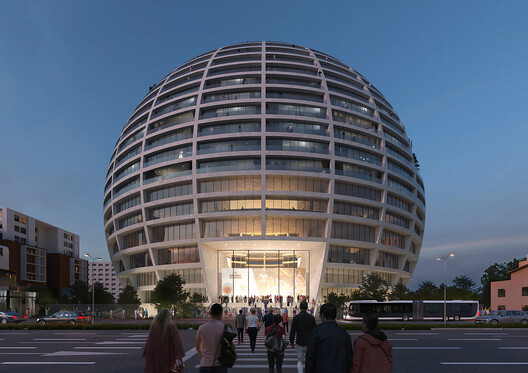
Tirana, the capital of Albania, is experiencing a rapid transformation driven by the long-term urban strategy outlined in the Tirana 2030 (TR030) Master Plan. Developed in 2017 by Stefano Boeri Architetti, UNLAB, and IND [Inter.National.Design] through a competition organized by the Ministry of Urban Development, the plan's objectives include increasing urban density, improving public infrastructure, and integrating green spaces and open areas into the urban fabric. It is in this dynamic setting that MVRDV has won the international competition for Tirana's new Asllan Rusi Sports Palace. Conceived as a mixed-use development, the project, named The Grand Ballroom, combines a 6,000-seat arena for basketball and volleyball with residential apartments, a hotel, and ground-level retail. With its spherical form exceeding 100 metres in diameter, the design adds a distinctive landmark to Tirana's growing collection of ambitious architectural projects.
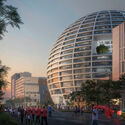
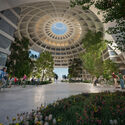
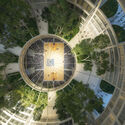
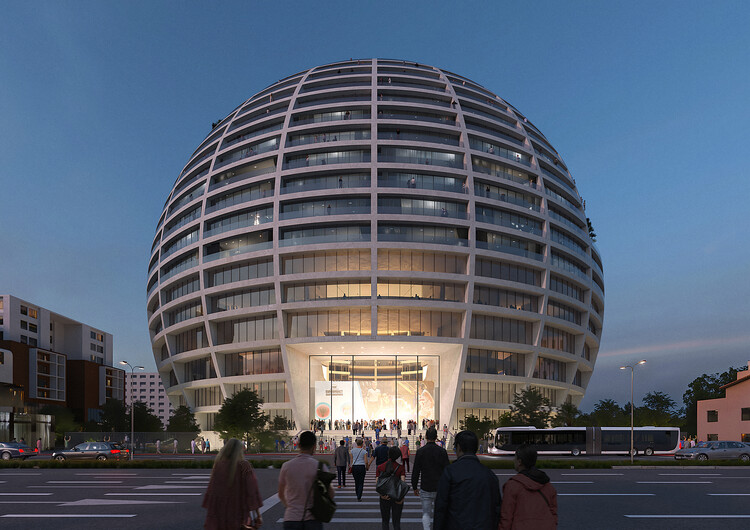
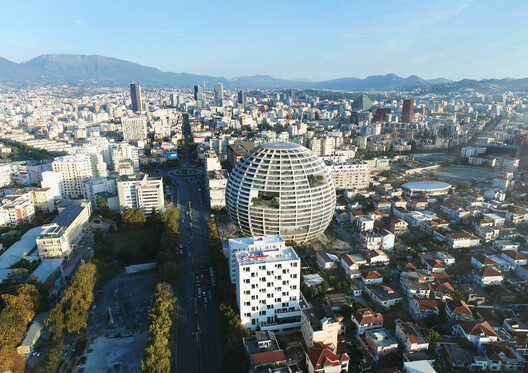
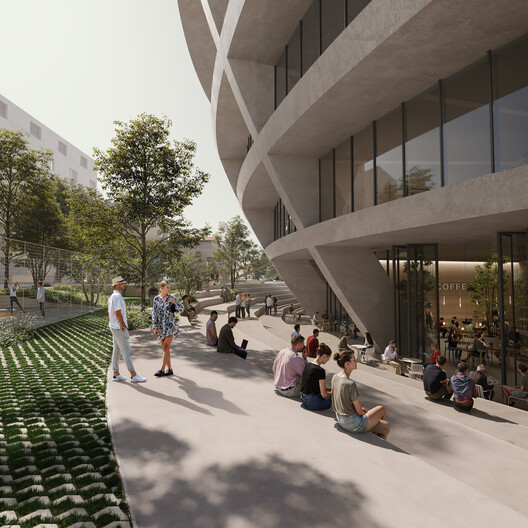
The functions of The Grand Ballroom are organized in layers. Where the spherical volume meets the ground, it creates a recessed plaza with steps and tribunes leading to a ring of retail spaces, cafés, and amenities that support the arena's operations. The main arena floor sits above this level, flanked by two hidden training courts beneath the stands. Two hotel floors rise above the arena, providing guests with direct views of the matches through room windows and from shared amenities that cantilever over the stands, forming a dramatic oculus at the arena's ceiling.
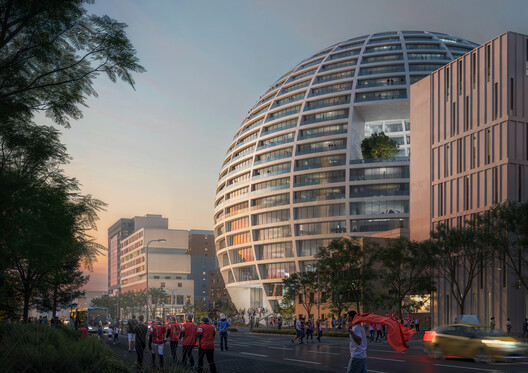
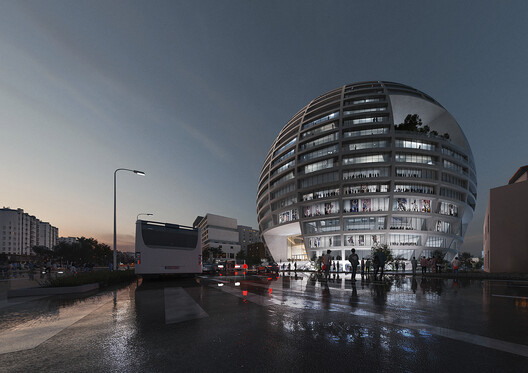
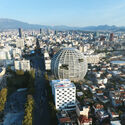
The design's spherical shape serves multiple purposes beyond its striking appearance. Positioned along the main road linking Tirana's airport and city centre, the form offers a 360-degree presence with no rear façade, integrating harmoniously with its surroundings. By stacking residential and hotel functions above the arena, the project seeks to maximize density on a compact site while freeing space at ground level for public plazas and outdoor sports facilities. The inward taper at the base opens the site to the city, while the taper at the top forms terraces for residents.
Related Article
Tirana Reimagined: Architectural Projects Transforming Albania's Capital through Public EngagementAbove the hotel, apartments are arranged within the sphere's double-shell structure, creating a semi-outdoor domed space that functions as a shared courtyard garden. The residences include a mix of outward-facing and dual-aspect units with views over both the city and the arena's oculus. The uppermost section houses duplex penthouses with private terraces and a hotel skybar offering panoramic city views. The composition culminates in a second glass-covered oculus that provides natural ventilation and light, completing MVRDV's vision of a self-contained vertical community.
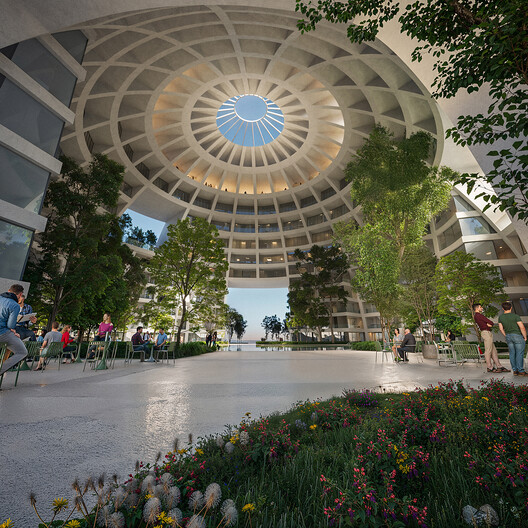
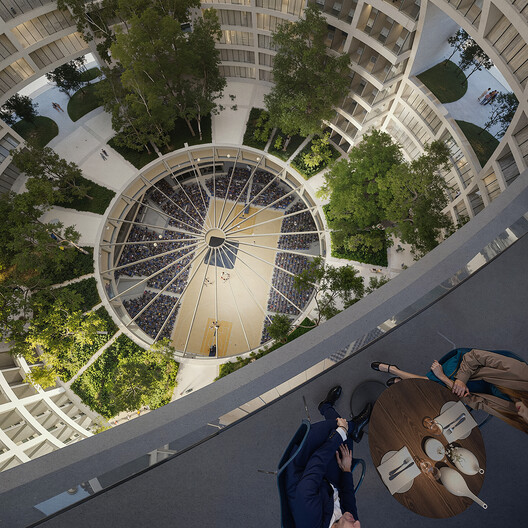
The spherical shape is a reference to the round ball used in so many sports. Yet it also recalls enlightenment temples, from Étienne-Louis Boullée's Cenotaph for Newton to Buckminster Fuller's tribute to technological optimism, the geodesic dome. A great sphere in the heart of Tirana can similarly become a temple to sport and community. By connecting the different functions, it invites everyone in the building to be part of the action. By providing public spaces complete with sports facilities, it becomes a part of its neighbourhood. By serving as a landmark, it draws people from all over the city and beyond to gather together and celebrate. It thus continues the growing Tirana Collection of new buildings. — Winy Maas, MVRDV founding partner
Other recent project announcements include Snøhetta's selected design for the Qiantang Bay Art Museum, a new cultural landmark within the Qiantang Bay Future Headquarters development in Hangzhou, China. Also in China, Zaha Hadid Architects' Yidan Center in Shenzhen, currently under construction, has reached its full height, while MVRDV has officially begun construction on The Sax, a major residential project located on Rotterdam's Wilhelminapier. In Indonesia, the Berlin-based non-profit organization Bauhaus Earth has developed BaleBio, a bamboo pavilion designed by Cave Urban to transform a disused car park into an open community meeting space.


